
On this day in 1992, NASA completed the first-ever 3-person spacewalk on the Space Shuttle Endeavour’s inaugural mission. Astronauts Richard J. Hieb, Thomas D. Akers and Pierre J. Thuot, pictured here, move a 4.5 ton communications satellite (about the size of a couple of Jeep’s). The mission also set a record for the first mission to feature 4 spacewalks. Fun facts: a spacewalk is usually called an EVA (aka “extravehicular activity), and it takes about 45 minutes to put on (aka “don”) a spacesuit. Also about the time it takes to watch an episode of Battlestar. So say we all. (Photo: NASA)
Morning Wake-Up Music

30 years ago: the Hubble Space Telescope was launched aboard the Space Shuttle Discovery (shown here). Built to give us a view from “the ultimate mountaintop,” Hubble led to new discoveries about black holes and an accelerating expansion of the universe. Fun fact: after astronauts completed the famed 1993 in-orbit repair, mission control played the song “I Can See Clearly Now” for the traditional wake-up music the following morning. Hubble will be succeeded by the James Webb Space Telescope, scheduled to launch in March 2021 on an Ariane 5 rocket from French Guiana, to observe the most distant objects and unexplored planets in the universe. For the Hubble’s 30th anniversary, you can download iconic images taken with the Wide Field and Planetary Camera 2 (aka “WFPC2”) via JPL. Great for backgrounds on those Zoom meetings. (Photo: NASA)
Splashdown
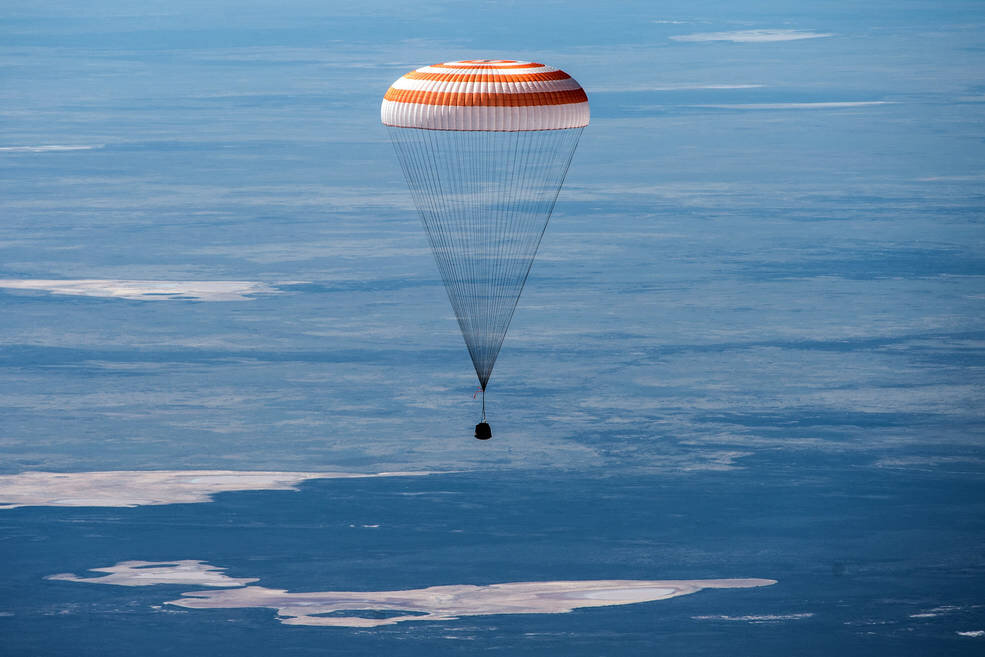
50 years ago today: the crew of Apollo 13 landed in the South Pacific after the most harrowing space rescue in history. As with every mission, backstage flight controllers & support teams on the ground played a critical role in solving problems to help guide the astronauts safely home. About their return, Mission Commander Jim Lovell said: "And as long as we could get over one crisis after another, we kept, you know, thinking positive until we finally made the landing.” Fast forward to last night: NASA astronauts Jessica Meir and Andrew Morgan, along with Cosmonaut (and Soyuz Commander) Oleg Skripochka, made this parachute-assisted landing in Kazakhstan after traveling over 100 million miles aboard the International Space Station. This crew of Expedition 62 studied the human body’s response to long-duration space flight, while Meir conducted the first of three all-woman spacewalks. (Photo: NASA)
Mailbox in Space

50 years ago today: on April 13, 1970, Apollo 13 was aborted after an oxygen tank ruptured on the way to the moon. Later deemed a “successful failure” because of experience gained in rescuing the crew, Apollo 13 became a case study of managing change and working together. The “Mailbox,” pictured here, helped bring astronauts Jim Lovell, Fred Haise, and Jack Swigert back to Earth. Because the original explosion happened in the Service Module, the astronauts had to use the Lunar Module as a lifeboat in space. So flight controllers and engineers on the ground created this DIY hack to make the air more breathable. (If you’re curious: the Mailbox connected the Command Module’s lithium hydroxide canisters, used to purge carbon dioxide, to the Lunar Module, which was carrying a limited amount of lithium hydroxide.) And as luck would have it, the CM’s filters were square…and the LM’s filters were round. You do what you can with the tools you have. (Photo: NASA)
What's Old is New Again

NASA’s red 80’s-era “worm” logo is back! Seen here on the SpaceX Falcon 9 rocket, the worm logo was originally designed by Richard Danne and introduced via the Federal Design Improvement Program in 1975. It was retired in 1992 in favor for the agency’s original 1950’s “meatball” graphic, but still used on clothing and other souvenir items. The Falcon 9 pictured above will help ferry astronauts to the International Space Station as part of SpaceX’s Demo-2 flight, now slated for mid-to-late May. (Photo: NASA)